Questions Q-84 – Q-108 | Study Sections S-20 – S-26
Question 1 of 25
✓ Correct: 0✗ Wrong: 00 of 25 answered
📚 Study Section S-20
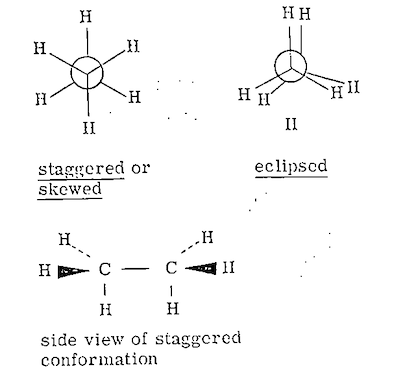
Atoms connected by single bonds are able to rotate about the bond. Atoms in double and triple bonds are not free to rotate. Atoms in a ring have restricted rotation. Consider the rotation of the C—C bond in ethane. Below are the end-on (projection) views of two of the various conformations possible for such a rotation.
Q-84
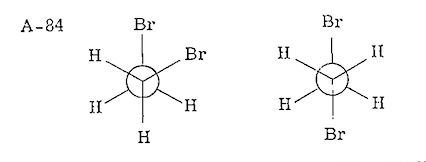
Draw two different end-on views of staggered 1, 2-dibromoethane.
A-84
Q-85
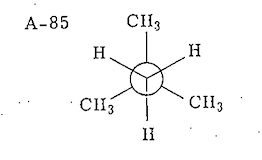
Draw an end-on view of the staggered conformation of neopentane.
A-85
Q-86
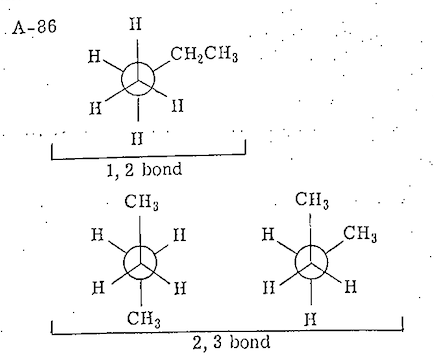
Draw end-on views of the staggered conformations of n-butane. One view should be down the 1, 2 carbon–carbon bond; the other view should be down the 2, 3–carbon–carbon bond.
A-86
📚 Study Section S-21
When two atoms move close to each other, there is physical or non-bonded or steric repulsion. Because of this, the staggered conformation of ethane is more stable than the eclipsed conformation.
Q-87
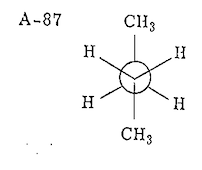
Draw an end on view of the most stable conformation of n-butane. Why do you think so?
A-87
Q-88
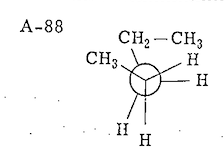
Draw an end on view of the least stable conformation of n-pentane about the 2, 3 bond.
A-88
Q-89
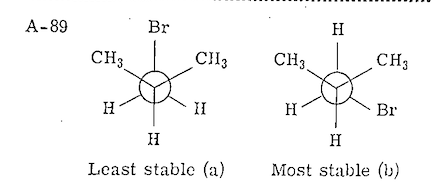
Draw an end-on view showing the least and most stable staggered conformation of i-butylbromide.
A-89
📚 Study Section S-22
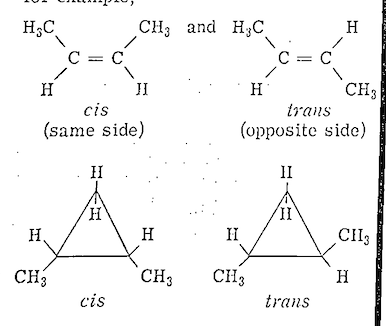
Compounds having restricted rotation about bonds (double bonds and ring compounds) can have “space” isomers; for example,
Q-90
Draw a structural formula indicating:
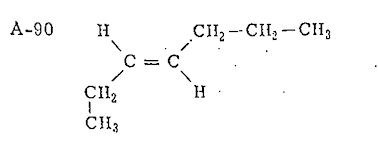
trans-3-heptene
A-90
Q-91
Draw a structural formula indicating:
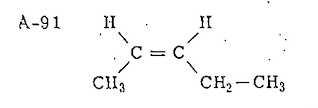
cis-2-pentene
A-91
Q-92
Draw a structural formula indicating:
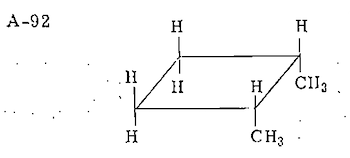
cis-1, 2-dimethylcyclobutane
A-92
Q-93
Draw a structural formula indicating:
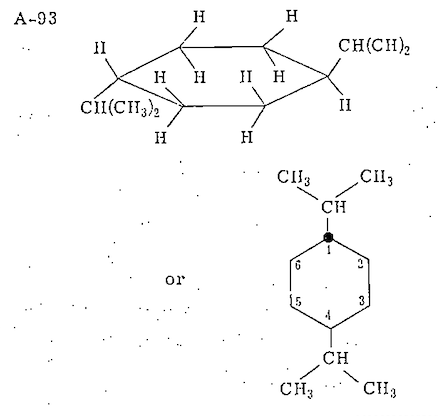
trans-1, 4-di-i-propylcyclohexane
A-93
Q-94
Draw a structural formula indicating:
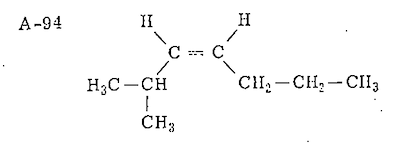
cis-2-methyl-3-heptene
A-94
Q-95
Draw a structural formula indicating:
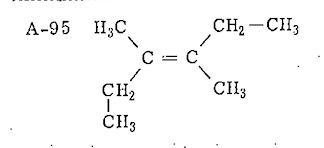
trans-3, 4-dimethyl-3-hexene
A-95
Q-96
Which of the following can have geometric (cis or trans) isomers?
a) 2-methyl-2-butene b) 2-butene c) 1-pentene d) 1-chloropropene
A-96
📚 Study Section S-23
The normal bond angle of carbon in an acyclic, saturated hydrocarbon is 109°28′ (tetrahedral angle). In cyclopropane the angles are 60° and are said to be strained. In C5 and larger ring compounds the strain of the ring carbons can be eliminated by “puckering” the ring; that is, all carbons are not in the same plane.
Q-97
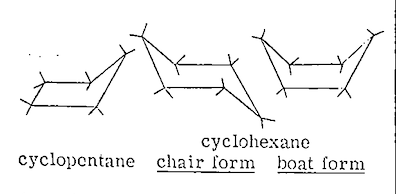
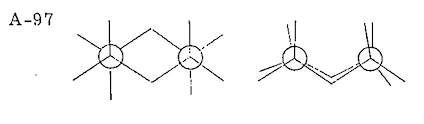
Draw an end-on view of the cyclohexane ring in both the chair and boat conformation.
A-97
Q-98
On the basis of your answer to Q-97, which conformation of cyclohexane would you consider most stable? Why?
A-98
Q-99
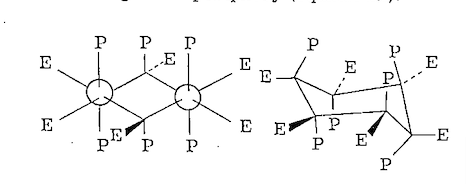
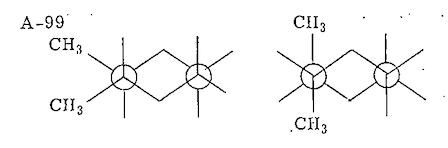
Draw two chair conformations (end-on view) of trans-1, 2-dimethylcyclohexane.
A-99
Q-100
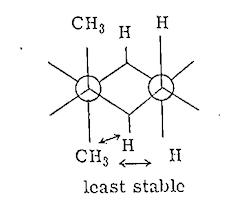
Of the two chair conformations possible for trans-1, 2-dimethylcyclohexane, which would you expect to be most stable? Why?
A-100
Q-101
Draw the structure of the most stable form of cis-1, 3-dibromocyclohexane and give the reason for your answer.
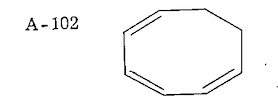
Draw the structure of a cyclooctatriene with three conjugated double bonds.
A-102
Q-103
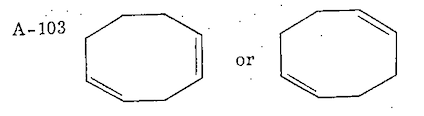
Draw the structure of a cyclooctadiene with two non-conjugated double bonds.
A-103
📚 Study Section S-25
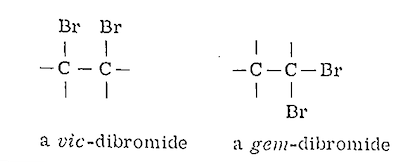
The term vic (vicinal) is sometimes used to denote two groups attached to adjacent carbon atoms. The term gem (geminal) indicates two groups attached to the same carbon atom; for example,
Q-104
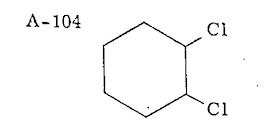
Draw the structure of a vic-cyclohexane-dichloride.
A-104
Q-105
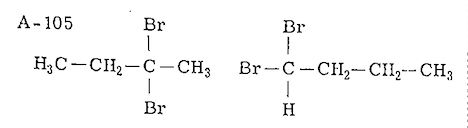
Draw the structure of two different gem-dibromides of n-butane.
A-105
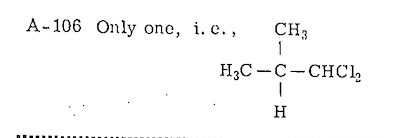
Q-106
How many isomeric gem-dihalo-i-butanes are there?
A-106
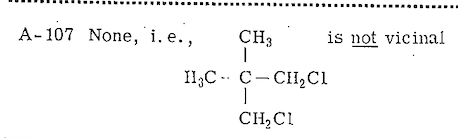
Q-107
How many isomeric vic-dihalo-neopentanes are there?