Module 2: Structure and Nomenclature of Aliphatic Hydrocarbons
Questions Q-27 – Q-83 | Study Sections S-5 – S-19
Question 1 of 57
✓ Correct: 0 ✗ Wrong: 0 0 of 57 answered
📚 Study Section S-5
A saturated branched acyclic hydrocarbon is named by prefixing the longest continuous carbon chain by the position (by number) and the name of the branch. The longest chain is numbered from one end to the other so that substituents have the lowest numbers possible; for example: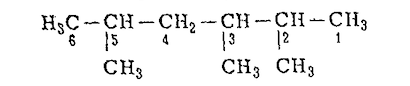 The branch (or radical) is named by giving the prefix indicating the number of carbons and the suffix -yl. For example:
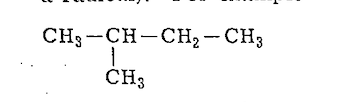 is named 2-methylbutane.
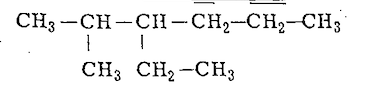 is named 2-methyl-3-ethylhexane.
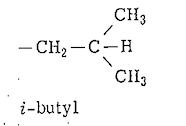
For some simple compounds the “common” names are retained, i.e., isobutane (i-butane) HC(CH₃)₃; isopentane (i-pentane) HC(CH₃)₂CH₂CH₃; isohexane (i-hexane) HC(CH₃)₂CH₂CH₂CH₃; neopentane (CH₃)₄C. given common names: i-propyl
 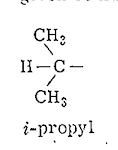 i-butyl
 i-pentyl secondary (sec-)butyl
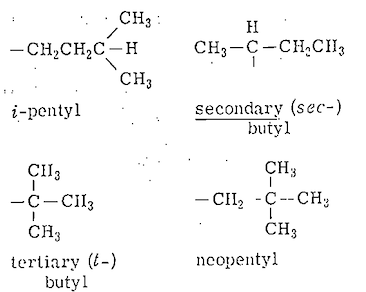 tertiary (t-)butyl neopentyl
The branch (or radical) is named by giving the prefix indicating the number of carbons and the suffix -yl. For example:is named 2-methylbutane.is named 2-methyl-3-ethylhexane.For some simple compounds the “common” names are retained, i.e., isobutane (i-butane) HC(CH₃)₃; isopentane (i-pentane) HC(CH₃)₂CH₂CH₃; isohexane (i-hexane) HC(CH₃)₂CH₂CH₂CH₃; neopentane (CH₃)₄C. given common names:
i-propyl i-butyli-pentyl secondary (sec-)butyltertiary (t-)butyl neopentylQ-27
Give a suitable name for:
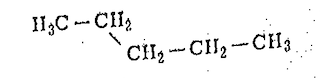
A-27
Pentane
Q-28
Give a suitable name for:
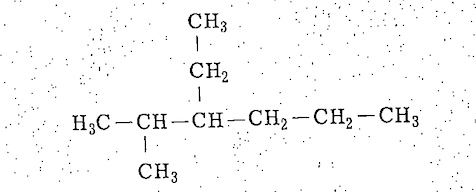
A-28
2-methyl-3-ethylhexane
Q-29
Give a suitable name for:
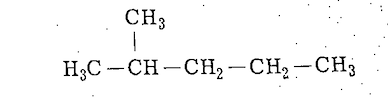
A-29
Isohexane or 2-methylpentane
Q-30
Give a suitable name for:
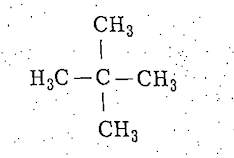
A-30
Isopentane or 2-methylbutane (not 3-methylbutane — give the radical the lowest possible number).
Q-31
Give a suitable name for:
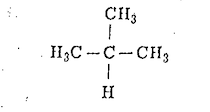
A-31
Isobutane or 2-methylpropane
Q-32
Give a suitable name for:
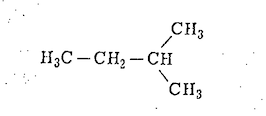
A-32
Isopentane or 2-methylbutane
Q-33
Give the structure of: i-heptane
A-33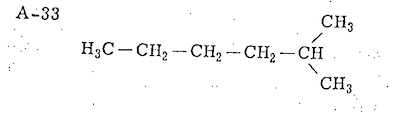
Q-34
Give the structure of: 2,3-dimethylpentane
A-34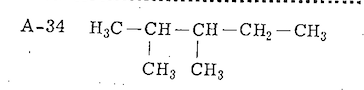
Q-35
What is wrong with this name: 3,4-dimethylpentane?
A-35
The chain is numbered so that the substituents have the highest numbers instead of the lowest. The correct name is 2,3-dimethylpentane.
Q-36
What is wrong with this name: 2-ethylpentane?
A-36
The longest chain is six carbons long. The compound should be named 3-methylhexane.
📚 Study Section S-6
To name alkanes containing a branched radical attached to the parent chain:
a) determine the longest continuous chain and number it so radicals have the lowest possible numbers;
b) name the longest chain;
c) prefix the chain name with the positions and names of the radicals;
d) branched radicals: give the name of the longest chain in the radical, add suffix -yl, and prefix the position and name of any radicals on the side chain.
The carbon atom of the radical attached directly to the parent chain is always designated as 1. For example, CH₃–CH₂–CH₂–CH–CH₂– (with CH₃ branch) is called a 2-methylpentyl radical.
Some simple radicals are given common names:i-propyl i-butyli-pentyl secondary (sec-)butyltertiary (t-)butyl neopentyl
a) determine the longest continuous chain and number it so radicals have the lowest possible numbers;
b) name the longest chain;
c) prefix the chain name with the positions and names of the radicals;
d) branched radicals: give the name of the longest chain in the radical, add suffix -yl, and prefix the position and name of any radicals on the side chain.
The carbon atom of the radical attached directly to the parent chain is always designated as 1. For example, CH₃–CH₂–CH₂–CH–CH₂– (with CH₃ branch) is called a 2-methylpentyl radical.
Some simple radicals are given common names:
i-propyl i-butyli-pentyl secondary (sec-)butyltertiary (t-)butyl neopentylQ-37
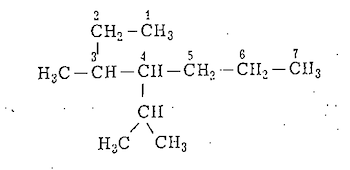
Give a suitable name for:
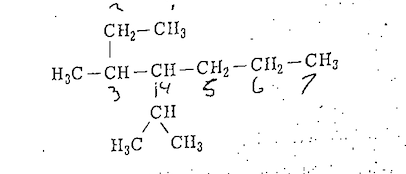
A-37
3-methyl-4-i-propylheptane
Q-38
Give a suitable name for:
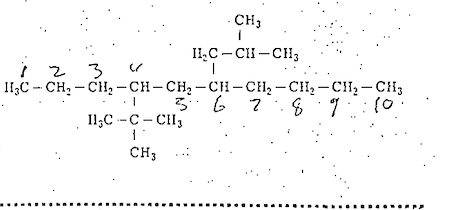
A-38
4-t-butyl-6-i-butyldecane
Q-39
Give a suitable name for:
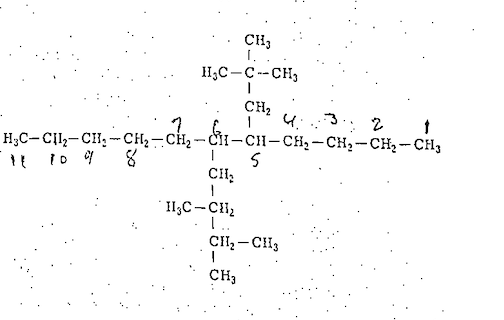
A-39
5-neopentyl-6-(2,3-dimethylbutyl)-undecane
Q-40
Give a suitable formula for: 5-s-butyl-5-(i-pentyl)-decane
A-40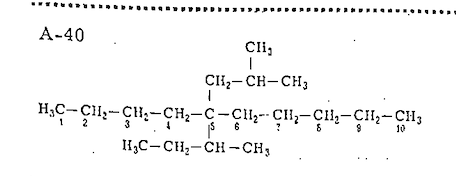
Q-41
What is wrong with this name: 4-(2-methylethyl)-heptane?
A-41
The 2-methylethyl group (–CH₂–CH₂–CH₃) is actually propyl. The compound should be named 4-propylheptane.
Q-42
What is wrong with this name: 4-(3-methylpentyl)-heptane?
A-42
The longest chain is nine carbons long. The compound should be called 3-methyl-6-propylnonane.
📚 Study Section S-7
If two or more side chains of different nature are present, they may be named in order of increasing complexity or alphabetically. Thus: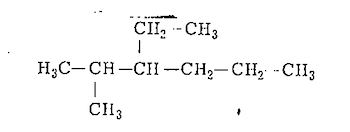 may be named either 3-ethyl-2-methylheptane (alphabetically) or 2-methyl-3-ethylheptane (complexity). When two possibilities exist for the longest continuous chain, the most highly branched chain is used as the parent.
may be named either 3-ethyl-2-methylheptane (alphabetically) or 2-methyl-3-ethylheptane (complexity). When two possibilities exist for the longest continuous chain, the most highly branched chain is used as the parent.Q-43
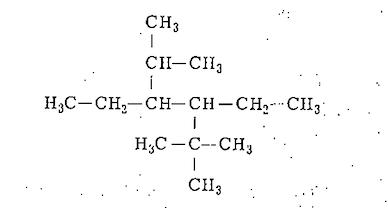
Give a suitable name for:
A-43
2,2,5-trimethyl-3,4-diethylhexane or 3,4-diethyl-2,2,5-trimethylhexane
(Not 3-i-propyl-4-t-butylhexane — that numbering does not give the most highly branched chain.)
(Not 3-i-propyl-4-t-butylhexane — that numbering does not give the most highly branched chain.)
📚 Study Section S-8
If two or more side chains occupy equivalent positions, the one assigned the lower number is cited first regardless of alphabetical or complexity order. 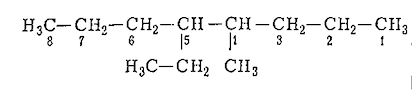 is 4-methyl-5-ethyloctane not 5-ethyl-4-methyloctane.
Identical radicals are indicated by the appropriate prefix: di, tri, tetra, penta, etc.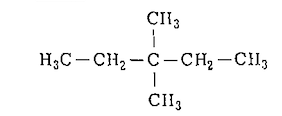 is 3,3-dimethylpentane.
is 4-methyl-5-ethyloctane not 5-ethyl-4-methyloctane.Identical radicals are indicated by the appropriate prefix: di, tri, tetra, penta, etc.
is 3,3-dimethylpentane.Q-44
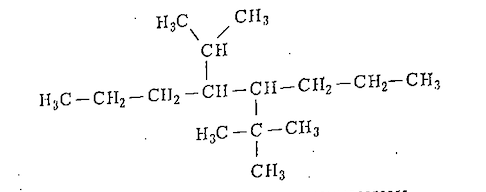
Give a suitable name for:
A-44
4-i-propyl-5-t-butyloctane
Q-45
Give a suitable name for:
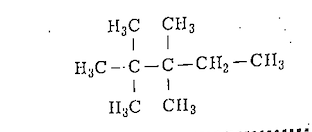
A-45
2,2,3,3-tetramethylpentane
Q-46
What is wrong with this name: 2,2,3,3-tetra-i-propylpentane?
A-46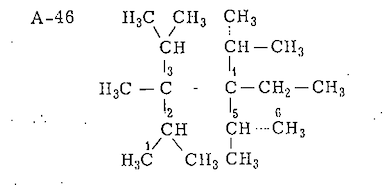 The longest chain is six atoms. The most highly branched six-membered chain, numbered as shown, gives the name 2,3,5-trimethyl-3,4-di-i-propyl-4-ethylhexane.
The longest chain is six atoms. The most highly branched six-membered chain, numbered as shown, gives the name 2,3,5-trimethyl-3,4-di-i-propyl-4-ethylhexane.📚 Study Section S-9
Identical radicals each substituted in the same way may be indicated by: bis (2), tris (3), tetrakis (4), etc. The complete side-chain expression may be enclosed in parentheses, or carbons of side chains may be indicated by prime numbers; for example: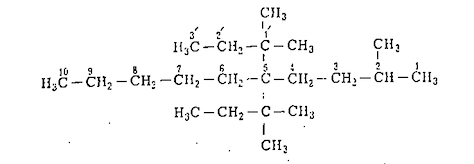 may be named either 2-methyl-5,5-bis-1′,1′-dimethylpropyldecane (primes) or 5,5-bis(1,1-dimethylpropyl)-2-methyldecane (parentheses).
may be named either 2-methyl-5,5-bis-1′,1′-dimethylpropyldecane (primes) or 5,5-bis(1,1-dimethylpropyl)-2-methyldecane (parentheses).Q-47
Give a suitable name for:
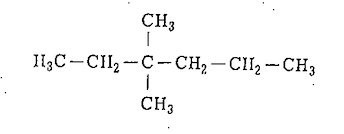
A-47
3,3-bis-methylhexane or 3,3-dimethylhexane
Q-48
Give a suitable name for:
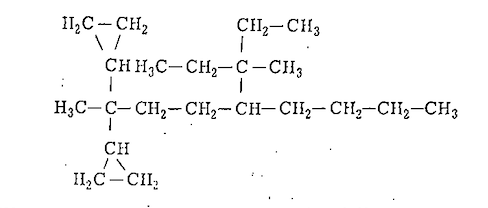
A-48
2,2-bis-cyclopropyl-5-(1-methyl-1-ethylpropyl)-nonane
📚 Study Section S-10
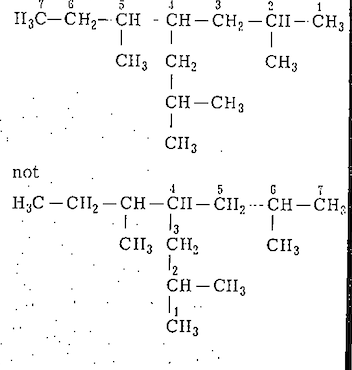
If chains of equal length compete for selection as the main chain in a saturated, branched, acyclic hydrocarbon, the choice goes to:
a) the chain with the greatest number of side chains: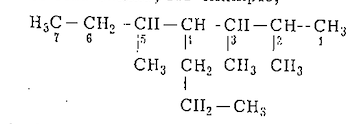 b) the chain whose side chains have the lowest numbered locations:
 c) the chain having the greatest number of carbon atoms in the smaller side chain: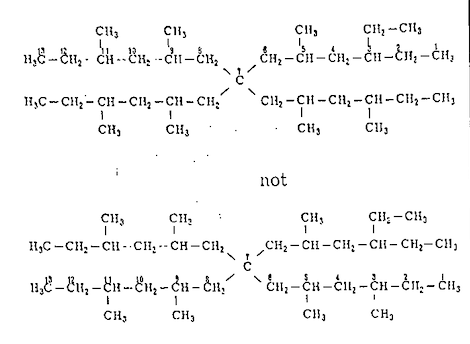
a) the chain with the greatest number of side chains:
b) the chain whose side chains have the lowest numbered locations:c) the chain having the greatest number of carbon atoms in the smaller side chain:Q-49
Number the following:
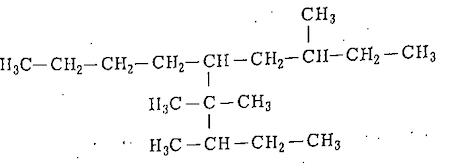
A-49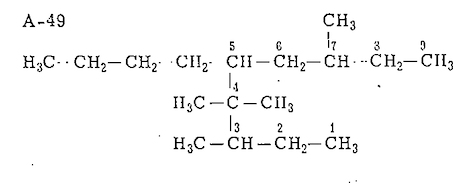
Q-50
Number the following:
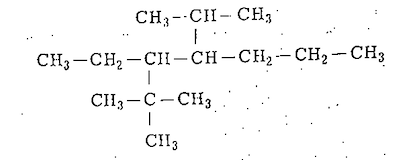
A-50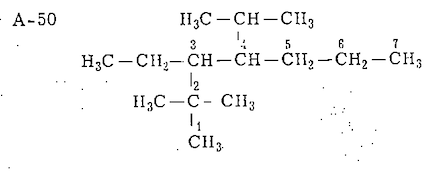
Q-51
Number the following:
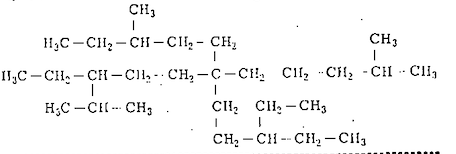
A-51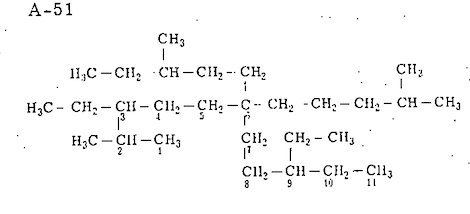
Q-52
Name the following:
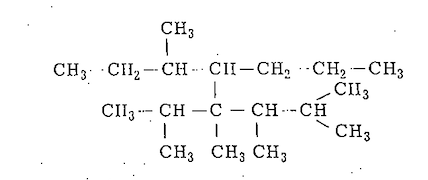
A-52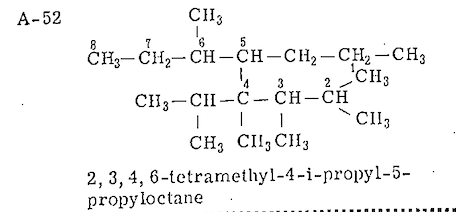
2,3,4,6-tetramethyl-4-i-propyl-5-propyloctane
2,3,4,6-tetramethyl-4-i-propyl-5-propyloctane
📚 Study Section S-11
Unsaturated, unbranched, acyclic hydrocarbons having double bonds are named by replacing the ending -ane with -ene. Two or more double bonds: -adiene, -atriene, etc. The chain is numbered to give double bonds the lowest possible numbers. Examples: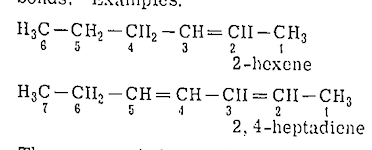 The names ethylene H₂C=CH₂ and allene H₂C=C=CH₂ are retained.
The names ethylene H₂C=CH₂ and allene H₂C=C=CH₂ are retained.Q-53
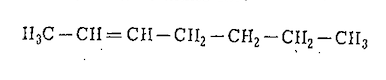
Give a suitable name for:
A-53
2-heptene
Q-54
Give a suitable name for:
H₂C=CH–CH=CH–CH₂–CH=CH–CH₃A-54
1,3,6-octatriene
Q-55
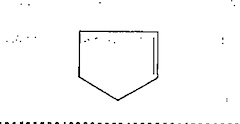
Give a suitable name for:
A-55
Cyclopentene
Q-56
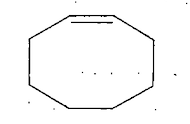
Give a suitable name for:
A-56
Cyclooctene
📚 Study Section S-12
Unsaturated, unbranched, acyclic hydrocarbons having triple bonds are named by replacing -ane with -yne. Two or more triple bonds: -adiyne, -atriyne, etc. The chain is numbered to give triple bonds the lowest possible numbers. The name acetylene for HC≡CH is retained.
Q-57
Give a suitable name for:
H₃C–C≡C–CH₂–CH₃A-57
2-pentyne
Q-58
Give a suitable name for:
H₃C–C≡C–C≡C–CH₃A-58
2,4-hexadiyne
📚 Study Section S-13
Hydrocarbons having both double and triple bond use the ending -enyne. When a choice exists, the double bond is given the lower number. The lowest possible numbers are given to the multiple bonds, even if this gives a lower number to -yne than to -ene.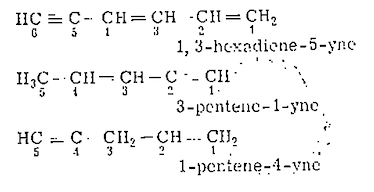
Q-59
Give a suitable name for:

A-59
1,5-heptadiene-3-yne
Q-60
Give a suitable name for:

A-60
4,7-nonadiene-2-yne
Q-61
What is wrong with this name: 4-hexene-2-yne?
A-61
H₃C–C≡C–CH=CH–CH₃. The double bond should have the lowest possible number, so the name should be 2-hexene-4-yne.
Q-62
What is wrong with this name: 2,5-octadiene-7-yne?
A-62
H₃C–CH=CH–CH₂–CH=CH–C≡CH. The multiple bonds should have the lowest possible numbers, so the name should be 3,6-octadiene-1-yne.
📚 Study Section S-14
Univalent radicals from unsaturated, acyclic hydrocarbons have endings -enyl, -ynyl, -dienyl, etc., with bond positions given when necessary.
Examples: ethenyl –CH=CH₂; 2-propenyl –CH₂–CH=CH₂; 1,3-butadienyl –CH=CH–CH=CH₂; 2-pentene-4-ynyl –CH₂–CH=CH–C≡CH.
Retained names: vinyl (ethenyl), allyl (2-propenyl), propenyl (1-methylvinyl).
Examples: ethenyl –CH=CH₂; 2-propenyl –CH₂–CH=CH₂; 1,3-butadienyl –CH=CH–CH=CH₂; 2-pentene-4-ynyl –CH₂–CH=CH–C≡CH.
Retained names: vinyl (ethenyl), allyl (2-propenyl), propenyl (1-methylvinyl).
Q-63
Give a suitable name for:
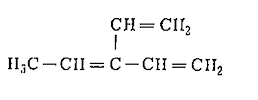
A-63
3-ethenyl (or vinyl)-1,3-pentadiene
Q-64
Give a suitable name for:
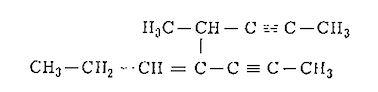
A-64
4-methyl-5-(1-propynyl)-5-nonene-2-yne
Q-65
Give a suitable name for:

A-65
Allyl chloride or 3-chloro-1-pentene
Q-66
Give a suitable name for:
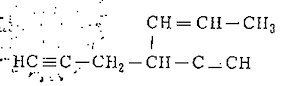
A-66
3-ethynyl-5-heptene-1-yne
📚 Study Section S-15
Unsaturated, branched, acyclic hydrocarbons are named as derivatives of the unbranched hydrocarbon containing the maximum number of double and triple bonds. If two or more chains compete, choose: 1) the one with the most carbon atoms; 2) if equal, the one with the most double bonds. Number to give the lowest numbers to multiple bonds.
Examples: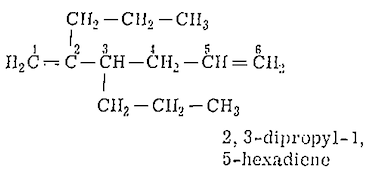 2,3-dipropyl-1,5-hexadiene
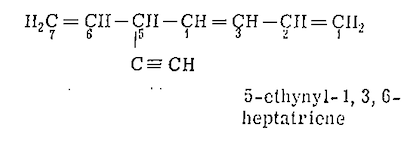 5-ethynyl-1,3,6-heptatriene
The name isoprene is retained for: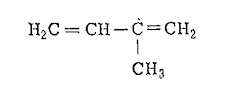
Examples:
2,3-dipropyl-1,5-hexadiene5-ethynyl-1,3,6-heptatrieneThe name isoprene is retained for:
Q-67
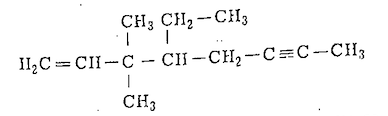
Give a suitable name for:
A-67
3,3-dimethyl-4-ethyl-1-octene-6-yne
Q-68
Give a suitable name for:
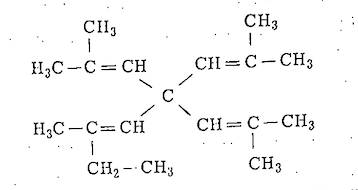
A-68
2,6-dimethyl-4,4-bis-(2-methyl-1-propenyl)-2,5-octadiene
Q-69
What is wrong with this name: 4-(1,1-dimethylpropyl)-5-heptene-2-yne?
A-69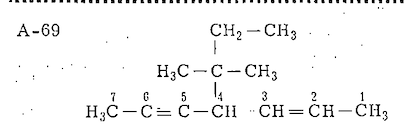 The lowest possible number should be given to the double bond. The correct name is 4-(1,1-dimethylpropyl)-2-heptene-5-yne.
The lowest possible number should be given to the double bond. The correct name is 4-(1,1-dimethylpropyl)-2-heptene-5-yne.📚 Study Section S-16
Bivalent and trivalent radicals from univalent, acyclic radicals (ending in -yl) are named by adding -idene or -idyne. The carbon with the free valence is numbered as one. Examples:
HC≡ = methylidyne H₃C–CH= = ethylidene H₃C–CH≡ = ethylidyne
H₂C=C= = vinylidene (CH₃)₂–C= = isopropylidene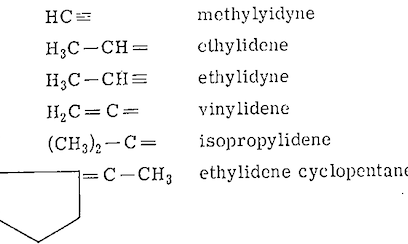 = ethylidene cyclopentane
HC≡ = methylidyne H₃C–CH= = ethylidene H₃C–CH≡ = ethylidyne
H₂C=C= = vinylidene (CH₃)₂–C= = isopropylidene
= ethylidene cyclopentaneQ-70
Give a suitable name for:
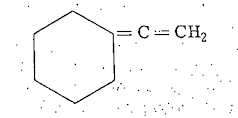
A-70
Vinylidenecyclohexane
Q-71
Give a suitable name for:
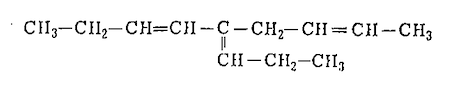
A-71
5-propylidene-2,6-nonadiene
Q-72
Give a suitable name for:
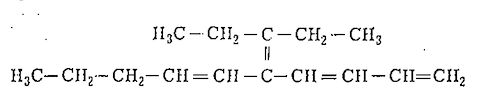
A-72
5-(1-ethylpropylidene)-1,3,6-decatriene
Q-73
Give a suitable name for:
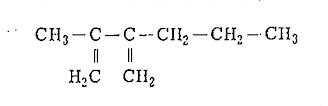
A-73
2-methyl-3-propyl-1,3-butadiene
Q-74
Give a suitable name for:
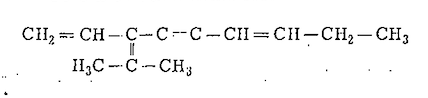
A-74
3-(1-methylpropylidene)-1,6-nonadiene-4-yne
📚 Study Section S-17
Cyclic alkanes and alkenes are named by prefixing cyclo- to the alkane or alkene name with the same number of carbon atoms:
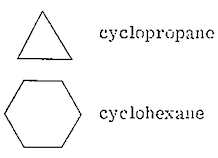 cyclopropane
  cyclohexane
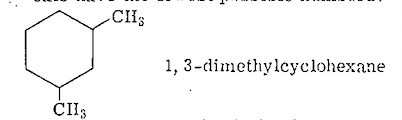
For compounds with both cyclic and acyclic chains, the cyclic system is the parent. Atoms in the ring are numbered consecutively so radicals have the lowest possible numbers.
 1,3-dimethylcyclohexane
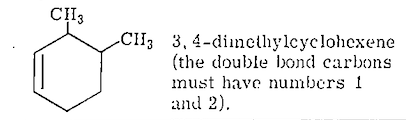
In cyclic alkenes, double bonds are given the lowest possible numbers (double bond carbons must have numbers 1 and 2).
cyclopropane cyclohexaneFor compounds with both cyclic and acyclic chains, the cyclic system is the parent. Atoms in the ring are numbered consecutively so radicals have the lowest possible numbers.
1,3-dimethylcyclohexaneIn cyclic alkenes, double bonds are given the lowest possible numbers (double bond carbons must have numbers 1 and 2).
Q-75
Give a suitable name for:
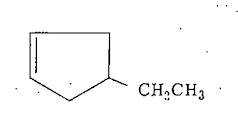
A-75
4-ethylcyclopentene
Q-76
Give a suitable name for:
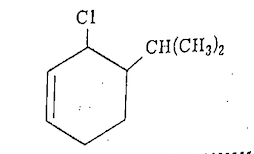
A-76
3-chloro-4-i-propylcyclohexene
Q-77
Give a suitable name for:
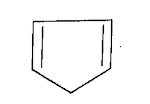
A-77
1,3-cyclopentadiene
Q-78
Give a suitable name for:
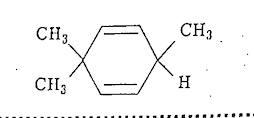
A-78
3,3,6-trimethyl-1,4-cyclohexadiene
📚 Study Section S-18
Univalent radicals from cycloalkanes are named by replacing -ane with -yl, the carbon with the free valence being numbered as one. Examples: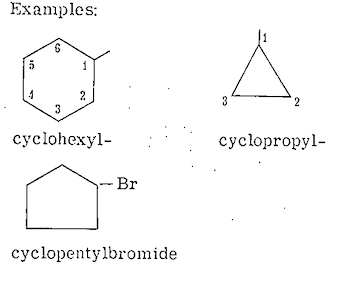 cyclohexyl– cyclopropyl– cyclopentylbromide
cyclohexyl– cyclopropyl– cyclopentylbromideQ-79
Give a suitable name for:
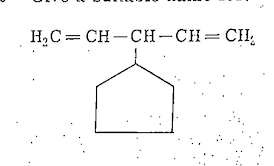
A-79
3-cyclopentyl-1,4-pentadiene
Q-80
Give a suitable name for:
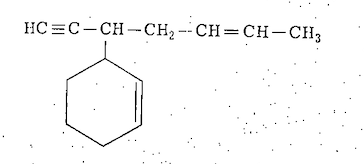
A-80
3-(2-cyclohexenyl)-5-pentene-1-yne
Q-81
Give a suitable name for:
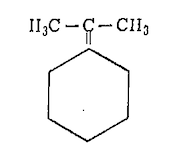
A-81
2-cyclohexylidene propane or isopropylidene cyclohexane
📚 Study Section S-19
Bivalent radicals from cyclic hydrocarbons (by removing H from two different ring carbons) are named by replacing -ane, -ene, -diene, -yne, etc. with -ylene, -ynylene, etc. Lowest numbers go to atoms with the free valences. Examples: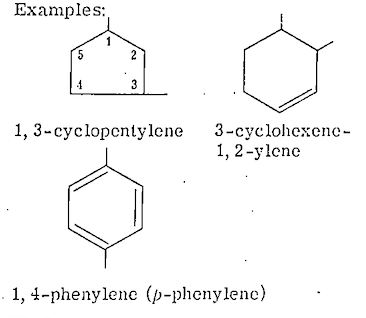 1,3-cyclopentylene 3-cyclohexene-1,2-ylene 1,4-phenylene (p-phenylene)
1,3-cyclopentylene 3-cyclohexene-1,2-ylene 1,4-phenylene (p-phenylene)Q-82
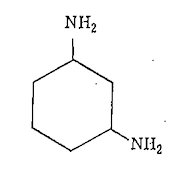
Give a suitable name for:
A-82
1,3-cyclohexylenediamine
Q-83
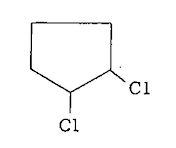
Give a suitable name for:
A-83
1,2-cyclopentylenedichloride
🎉